Ariel Childs Books: Inspiring Children's Literature
Exodus
Exodus 1 and 2
These lessons cover the early life of Moses, including his rescue from death and upbringing in Pharaoh’s palace. They highlight how God prepared him to become a leader. Students will explore Moses’ calling to lead God’s people out of bondage in Egypt.
When Fear Goes Too Far
Scripture Focus: Exodus 1:6–22 (summarized)
Theme: Understanding good fear vs. bad fear and trusting God to help us respond well.
Time Needed: 30–40 minutes
1. Opening Discussion (5 minutes)
Read your passage aloud:
Joseph died, and so did his brothers. A new Pharaoh came to power in Egypt. He didn’t know about Joseph or how he had helped Egypt. But he saw that the Israelites were growing in number. They were strong, and their families kept getting bigger.
Pharaoh became afraid. He worried, “What if they turn against us and join our enemies?” So he made the Israelites into slaves. He forced them to work hard and tried to crush their hope. But the more he hurt them, the more they multiplied.
So Pharaoh came up with an even worse plan. He ordered that all the baby boys born to the Israelites be killed. He thought that if there were no men, there would be no army to rise up against him.
Ask:
Why was Pharaoh afraid?
What did Pharaoh do because of his fear?
Was Pharaoh’s fear good or bad? Why?
2. Read the Reflection (5 minutes)
Fear can be a good thing. It can keep us from danger—like running into traffic or touching fire. But there’s also a bad kind of fear. Bad fear makes people treat others unfairly. It can lead to hate, cruelty, and even violence—just like Pharaoh’s fear did.
We must be careful with our fear. We can ask God to help us respond with love and wisdom instead of letting fear control us.
Ask:
Can you think of a time when fear helped you stay safe?
Can you think of a time when fear made someone do something wrong?
3. Memory Verse (5 minutes)
2 Timothy 1:7 (NIV) “For the Spirit God gave us does not make us timid, but gives us power, love and self-discipline.”
Practice saying it together with simple hand motions for “power,” “love,” and “self-discipline.”
4. Activity: “Good Fear or Bad Fear?” (15 minutes)
Materials:
Small slips of paper or index cards
Markers
Two boxes or baskets labeled “Good Fear” and “Bad Fear”
Instructions:
1. Write examples of fears on cards (e.g., “afraid of running into the street,” “afraid someone will take your things,” “afraid of getting sick,” “afraid of someone who looks different,” “afraid of heights,” “afraid to try something new”).
2. Give each child one or two cards and ask them to decide if it is a good fear or bad fear and place the card in the correct box.
3. Discuss the answers together.
Which fears help keep us safe?
Which fears might make us treat others unfairly?
How can we ask God to help us with our fears?
4. Wrap-Up & Prayer (5 minutes)
Summarize:
Fear can protect us or cause us to make bad choices.
· Pharaoh’s fear led to bad choices and hurt many people.
· God wants to help us face fear with love, courage, and wisdom.
Close in prayer asking God to help everyone handle fear in a good way.
Baby Moses – God Has a Plan
Lesson Summary:
Moses’ mother wasn’t willing to throw her newborn son into the Nile River like Pharaoh commanded. She hid him for three months, but when she could no longer keep him hidden, she made a small boat out of reeds and covered it with tar to keep it waterproof. She placed baby Moses in the basket and set it among the reeds along the riverbank. His older sister, Miriam, stood nearby to watch what would happen.
Pharaoh’s daughter just happened to come to the river to bathe. She noticed the basket and sent her servant to retrieve it. When she opened it, she saw the baby crying and felt sorry for him. Miriam stepped up and offered to find someone to take care of the baby. She brought their mother—and Pharaoh’s daughter paid her to nurse and care for Moses until he was old enough to live in the palace. Pharaoh’s daughter named him Moses, which means “drawn out,” because she drew him out of the water.
Main Point:
This story reminds us that God is always in control, even when things seem dangerous or uncertain. God had a special plan for Moses’ life—and He has a special plan for your life, too. Every part of Moses’ story—being hidden, the basket, Pharaoh’s daughter finding him—was part of God’s plan.
Memory Verse:
Jeremiah 29:11 (NIV)
“For I know the plans I have for you,” declares the Lord, “plans to prosper you and not to harm you,
Plans to give you a hope and a future.”
Activity: “Basket of Purpose” Craft & Reflection
Materials:
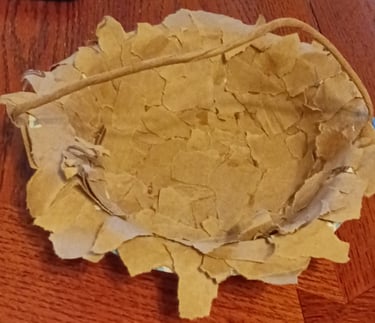
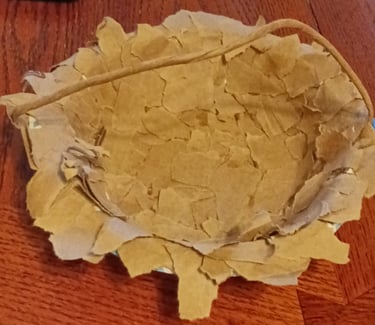
Paper bowls or small containers (to represent baskets)
Yarn, string, or brown paper strips (for “reeds”)
Tape or glue
Markers
Small slips of paper
Instructions:
1. Let students decorate their “basket” with paper strips and yarn to look like Moses’ basket.
2. Ask them to write 2–3 things about themselves on the slips of paper (skills, things they enjoy, dreams for the future).
3. Place the slips inside the basket.
4. Discuss how just like Moses was placed in a basket with a special purpose, they too have a purpose—and God is shaping their story even now.
Optional Discussion Questions:
1. Why do you think Moses’ mom was so brave?
2. How do you think Miriam felt when watching her baby brother float down the river?
3. Can you think of a time when God protected or helped you or someone you love?

Moses Takes Matters into His Own Hands
Moses had grown up in Pharaoh’s palace, treated like royalty. But deep down, he knew he didn’t really belong there. He was a Hebrew—one of the very people who were being treated unfairly and forced to work as slaves.
As Moses got older, he saw how badly his people were being treated. It hurt him deeply. He wanted to use his high position in the palace to help them. But one day, that pain turned into anger.
He saw an Egyptian beating a Hebrew slave—one of his own people. Instead of thinking things through or asking God what to do, Moses acted fast. He looked around to make sure no one was watching, then killed the Egyptian and buried him in the sand.
The next day, Moses saw two Hebrews fighting. He stepped in and said, “Why are you fighting your own people?” But one of the men snapped back, “What—are you going to kill me like you killed that Egyptian?”
Moses was shocked. People knew. And when Pharaoh heard about it, he put a price on Moses’ head. Moses had to run for his life.
Think About It
Moses wanted to help—but he didn’t ask God how. He let his emotions lead, and it cost him everything. Sometimes we feel the same way. We see wrong things happening—people hurting others, unfairness, bullying—and we want to fix it right away. But if we let our anger take over, we might hurt more than we help.
God wants us to care about justice, just like Moses did. But He also wants us to listen first, pray, and wait on His direction.
Activity: Stop and Ask
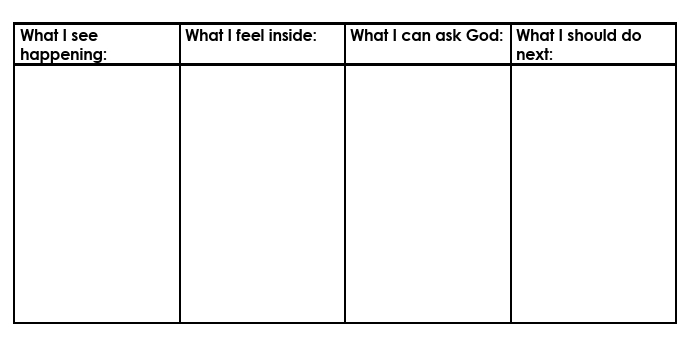
Draw or write in a box like this when you see something wrong:
What I see happening:
What I feel inside:
What I can ask God:
What I should do next:
Example:
What I see: A classmate being made fun of.
What I feel: Mad, sad, unsure.
What I can ask God: “How can I help without causing more hurt?”
What I should do next: Speak up kindly. Ask a teacher. Be a friend.